Pool Deck Materials: Travertine vs. Pavers vs. Porcelain vs. Concrete (Heat, Slip, Salt & Cost)
Heat underfoot is set first by COLOR (light reflects sunlight, dark absorbs it — buy light), then by the material's own heat behavior: dense stone, porcelain, and thick concrete absorb and store the most heat and transfer it to bare feet the fastest (so they feel hottest and stay hot into the evening), while porous stone dissipates heat and low-mass coatings and boards feel gentler at the same temperature. A light travertine or light porcelain stays walkable (roughly 95–120°F); a dark porcelain or dark stone cooks bare feet (140°F+). After heat, the material decides the rest: light 2cm porcelain is the best all-arounder (coolest-per-dollar when light, inert so it shrugs off salt and chlorine with no sealing, replaceable) — just demand a real slip rating (DCOF ≥ 0.42 or R11–R12). Light travertine is the best natural look and stays cool and grippy, but it's porous carbonate you must keep sealed, especially near a salt pool. Concrete pavers are the value pick — tough, endlessly styled, and repaired one unit at a time. Poured concrete is cheapest but cracks and gets hot; a light cool-deck acrylic coating runs 15–40°F cooler and is the cheapest cool-and-grippy surface (and the way to rescue an existing hot, cracked slab). For a raised or above-ground deck, composite (inert, low-maintenance, 25+ years) beats wood on upkeep and salt. Installed 2026, expect roughly: cool-deck coating $4–$9, poured concrete $4–$18, brick/concrete pavers $5–$28, limestone/travertine/shellstone $15–$40, porcelain $20–$32, composite $40–$85. In Florida the real failure point isn't the material — it's the paver base, so spend there no matter what goes on top.
The deck is the biggest surface around your pool — more square footage than the water itself — and in Florida sun the material decides a lot more than how it looks. It sets how hot it is underfoot at 2 p.m., how slippery it is with wet feet, how it stands up to salt and splash-out, whether the field cracks or settles as the ground moves, and what you pay to build and maintain it.
Here’s the honest comparison, with real 2026 installed prices — and the thing showrooms bury: how hot a deck feels is set first by its color, then by how much heat the material itself stores and pushes back into your feet.
Start here: two things set how hot a deck feels — color, then the material itself
Before you compare travertine to porcelain to concrete, settle the temperature question, because it swamps almost everything else on a bare-foot deck. Two forces are at work: how much heat the surface absorbs (mostly color), and what the material then does with that heat — how much it stores and how fast it dumps into your foot.
Color sets how much heat gets absorbed — the biggest single lever. Light surfaces bounce back 60–80% of sunlight; dark surfaces soak up 70–90%. Gray broom concrete reflects only about 0.18–0.22 of the sun (absorbs ~80%); ivory travertine reflects 0.55–0.62. That’s why a light deck stays walkable and a dark one bakes — and it’s the standardized physics behind the Solar Reflectance Index (SRI, ASTM E1980), not marketing. A dark porcelain and a dark stone both cook (140°F+); a light porcelain and a light travertine both stay walkable (~95–120°F vs. 130–145°F for dark concrete). The classic showroom trap is being sold a dark tile as “cool because it’s porcelain.” It isn’t. Buy light first.
Then the material decides how much heat it banks and how fast it burns your foot. Two material properties finish the story, and no color choice overrides them:
- Heat retention (thermal mass). Dense, heavy materials — natural stone, porcelain, and especially a thick poured slab — absorb and store a lot of heat, so they stay hot deep into the evening after the sun moves off. Low-mass surfaces (a thin acrylic cool-deck coating, or a composite/wood board over an open airspace) bank far less, so they heat and cool faster and don’t hold the afternoon’s heat as long. Porous natural stone (travertine, limestone, shellstone) has a genuine extra edge here: it wicks and dissipates heat, and a splash of water flashes it cooler.
- How fast it transfers to your skin (the “feels hot” property). Two surfaces at the same measured temperature don’t feel the same underfoot. Dense stone, porcelain, and concrete pull heat into bare skin quickly, so they feel hot instantly; wood and composite move heat into your foot much more slowly, so they feel gentler at the same temperature — part of why a wood or ipe deck reads cooler than a thermometer alone suggests.
The rule to remember: color is the biggest lever (buy light), but the material finishes the job — dense stone, porcelain, and concrete absorb and hold the most heat and transfer it to your foot the fastest, while porous stone dissipates heat and low-mass boards and coatings feel gentler. So the coolest deck is light-colored and either porous or low-mass; the worst is dark, dense, and heavy. One material breaks the color rule outright: artificial turf runs hotter than anything else here no matter what shade it is — its own section is below.
(A note on the temperature numbers: surface-temp figures for decks are contractor- and supplier-reported, not lab studies, so treat them as ranges. The defensible mechanisms are textbook: solar reflectance (color) sets how much heat is absorbed, and the material’s thermal mass and how fast it conducts into skin set how long it stays hot and how hot it feels — so buy light, and favor a porous or low-mass surface, regardless of whose thermometer it was.)
At a glance (heat shown for a LIGHT tone)
| Material | Heat underfoot (light tone, peak sun) | Wet slip | Salt / chemistry | Maintenance | Durability & repair | Installed $/sq ft |
|---|---|---|---|---|---|---|
| Cool-deck coating (acrylic overlay) | Cool (15–40°F under bare concrete) | Excellent (grit) | Weak — coating degrades | Recoat 5–12 yr | Won’t bridge slab cracks | $4–$9 |
| Poured concrete (broom) | Hot if gray; warm if tinted light | Excellent (broom) | Medium — spalls unsealed | Low–med | Cracks; no spot-repair | $4–$12 |
| Stamped concrete | Warm–hot | Poor–fair (sealer slick) | Medium | Reseal 2–3 yr, fades | Cracks; no invisible fix | $8–$18 |
| Concrete / brick pavers | Warm (hot if dark) | Good (textured) | Medium — salt wears joint sand | Low; re-sand joints | High — 30–50 yr, replace one unit | $16–$28 (brick $5–$25) |
| Travertine | Cool (~95–120°F) | Excellent (tumbled) | Medium — carbonate, seal it | Seal 2–3 yr (annual near salt) | High, 25–40 yr, piece-replaceable | $17–$28 |
| Limestone | Cool (light carbonate) | Good (tumbled/brushed) | Medium — etches, seal it | Seal periodically | High, 25+ yr, piece-replaceable | $15–$30 |
| Shellstone / coral | Cool | Good | Low–med — most porous, MUST seal | Med–high; mold-prone | High, piece-replaceable, softer | $15–$40 |
| Marble (white/dolomite) | Coolest (white) | Good tumbled; bad polished | Weakest — etches; salt = frequent reseal | High | Etch = cosmetic wear | $24–$38 |
| Porcelain (2cm pavers) | Cool if light (140°F+ if dark) | Best-in-class IF slip-rated | Best — inert, no seal | Lowest | High, 50–70 yr, brittle to impact | $20–$32 |
| Flagstone — sandstone/quartzite | Cool-ish | Very good (cleft) | Medium — seal porous types | Seal periodically | High, natural | $15–$30 |
| Flagstone — bluestone | Hot in FL sun (dark) | Slick wet if sawn/thermal | Medium | Seal | High | $18–$35 |
| Composite decking | Warm; light/heat-tech ~30–35°F cooler than dark | Good (slick if dirty) | Excellent — inert | Low (no seal) | 25–30 yr; board-replace | $40–$85 |
| Natural wood (PT / cedar / ipe) | Warm (ipe ~136°F, dissipates fast) | Fair (splinters, algae film) | Poor — rots/swells near splash | High — sand & seal | PT 10–15 yr; ipe 40–75 yr | pine $15–$40, ipe $50–$80 |
| Artificial turf | Hottest surface on this page — color barely helps | Good (drains, not slick) | Excellent — inert | Low (rinse, brush, top up infill) | 15–25 yr; seams and infill wear | $12–$22 |
Cool carbonate stones — the coolest natural look (seal them)
Travertine, limestone, shellstone/coral, and marble are all light carbonate stone, and they share a story: they stay cool and grippy, they’re porous so they must be sealed, and near a salt pool that sealing schedule tightens (dried salt splash crystallizes in the pores and can spall the surface).
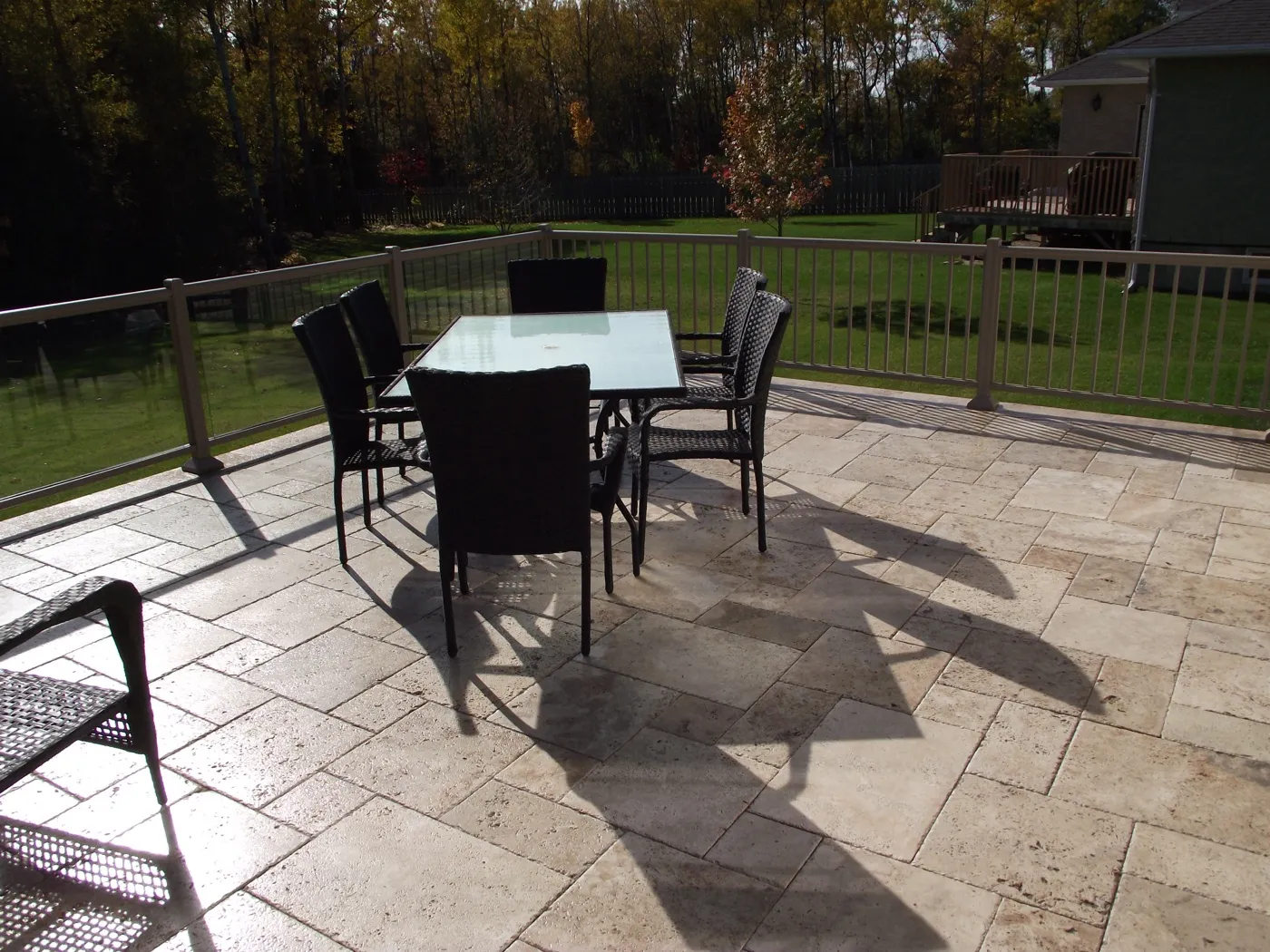
- Travertine is the Florida favorite — cool underfoot (~95–120°F, 20–40°F cooler than dark concrete), naturally non-slip tumbled, and piece-replaceable. Seal it every 2–3 years (annually near heavy salt splash). About $17–$28 installed.
- Limestone is travertine’s sibling — same cool, light, sealed-carbonate profile with a slightly more uniform look; good slip when tumbled or brushed, $15–$30, 25+ years, piece-replaceable. Think of it with travertine as “cool carbonate, seal it.”
- Shellstone / coral stone is the coastal-look regional option and the most porous of the group, so it has the highest sealing and mold burden — but it’s genuinely cool and softer underfoot. $15–$40 (regional).
- Marble (white/dolomite) measures the coolest on paper, but it’s the most acid-sensitive stone — pool chemistry, salt, and sunscreen etch it — and polished marble is a slip hazard. Use it tumbled, expect to maintain it, and know it’s a luxury surface you baby. $24–$38.
Manufactured pavers — the value and the low-maintenance picks
Concrete pavers are the value champion: a huge range of styles and colors, they shrug off chlorine, and they’re the only deck you repair one unit at a time — lift a stained paver and drop in a new one, no crack to patch. They run warm (hot if you pick a dark color, so buy light), the joint sand wears over years (re-sand occasionally, use polymeric sand near salt), and color can fade. Roughly $16–$28 installed, and they last 30–50 years. Brick pavers are the classic warm-toned version — durable and textured, but they run hot and can grow moss in damp shade; $5–$25.
Porcelain pavers (2cm) are the lowest-maintenance deck there is: dense and inert, so they never fade, never need sealing, and are completely indifferent to salt and chlorine. Light porcelain stays cool; dark porcelain hits 140°F+ (color, again). The one thing you must do is demand a real slip rating — a smooth porcelain is dangerously slick wet. Spec DCOF ≥ 0.42 (ANSI A137.1) or R11–R12 (DIN 51130), and ideally a barefoot DIN 51097 class B. They’re brittle to point impact and need a skilled installer, but for set-and-forget they’re the best. $20–$32 installed.
Best all-around pick: light 2cm porcelain with a real slip rating — coolest-per-dollar when light, zero chemistry worry, no sealing, replaceable. Best value: light concrete pavers. Best natural look: light travertine (if you’ll keep it sealed).
Poured concrete and coatings — the budget lane
Plain broom-finish concrete is the cheapest deck ($4–$12/sq ft) and, textured with a broom, actually has excellent wet grip. The catches: gray concrete bakes bare feet, a slab cracks with Florida’s moving soil, and there’s no spot-repair — you live with the crack or resurface. A light integral tint helps the heat a little.
Stamped concrete tries to mimic stone or brick for less ($8–$18), but it stacks the three most common deck complaints into one product: it cracks (and the crack cuts across the pattern, impossible to hide), the sealer that makes it look good is slick unless a grit additive is mixed in, and it runs hot. Reseal every 2–3 years as it fades. Buy it for looks-on-a-budget with eyes open.
Cool-deck acrylic coating (spray-knockdown / micro-topping, “Kool Deck”-style) is the sleeper pick and the resurfacing answer: sprayed over a sound slab it runs 15–40°F cooler than bare gray concrete (color-dependent — buy light), gives a grippy grit texture, and is the cheapest cool-and-safe surface at $4–$9. It’s also how you rescue an existing hot, cracked slab without tearing it out. Two honest limits: it does not bridge cracks (a moving slab crack telegraphs back through), and it recoats every 5–12 years (sooner if dark, badly prepped, or hit by sprinkler overspray). Salt slowly degrades the coating, and it’s a deck-field surface, not for coping or raised edges.
Flagstone — it depends entirely on the stone
“Flagstone” isn’t one material, and the choice makes or breaks it in Florida:
- Sandstone / quartzite is cool-ish and very slip-safe thanks to its natural cleft texture; seal the porous types. $15–$30. A good natural pick here.
- Bluestone is dark, so it runs hot in full Florida sun, and the sawn/thermal finish gets slick when wet. Beautiful, but in our climate it belongs in shade or as an accent, not as the main bare-foot field. $18–$35.
Raised & above-ground decks — composite vs. wood
For a raised deck or an above-ground pool, you’re choosing between two board materials, not pavers:
- Composite (Trex, TimberTech, AZEK) is the low-drama winner: inert, so salt and chlorine don’t touch it, no sealing, and 25–30 years of life (board-replaceable). Dark boards get hot (~148°F); light and “heat-mitigating” lines run ~30–35°F cooler — buy light. Grip is good (slick only when dirty). The cost is in the substructure/framing, so it lands at $40–$85 installed. Downsides: it can mildew without airflow, and scratches can’t be sanded out.
- Natural wood (pressure-treated pine, cedar, ipe) is cheaper up front and warmer in look — ipe even runs cooler than dark composite (~136–137°F, dissipating fast) — but it’s poor near constant pool splash (rots, swells, splinters; salt makes it worse) and it’s high-maintenance (sand and seal every 2–3 years, closer to yearly poolside; ipe wants a UV oil 1–2 years or it silvers). Pine lasts 10–15 years, ipe 40–75. Wood wins on upfront cost and warmth; composite wins on maintenance, salt resistance, and lifespan-per-effort.
Artificial turf — the exception to the “buy light” rule
Turf is the one surface here where color barely rescues you, and it’s the only material on this page with peer-reviewed temperature data behind it — which is worth knowing before someone sells you a turf sunbathing area.
A 2024 systematic review of synthetic grass surfaces found them running 9.4–33.7 °C hotter than natural grass — that’s roughly 17–61 °F — with maximum recorded surface temperatures up to 86.6 °C (about 188 °F). Penn State’s Center for Sports Surface Research puts the everyday gap at 35–55 °F above natural grass. For comparison, the hottest thing else on this page is a dark porcelain or dark slab at 140–150 °F. Turf beats it, in the wrong direction, and a “light” turf doesn’t fix it: the same review found red and green fibres measured statistically the same.
The nuance nobody selling turf mentions, and it cuts both ways: the review found the air temperature above synthetic grass was only 0.5–1.2 °C higher than above natural grass. So turf does not heat your yard — it is a contact problem, not a climate one. It will not make your patio hotter to sit on. It will burn the soles of your feet, and children and dogs feel it first.
If you are buying turf, buy the infill, not the marketing. That same review is specific about what actually moved the number: surfaces with styrene-butadiene rubber (crumb rubber) infill or a shock pad measured hotter, while thermoplastic elastomer (TPE) infill, “cool” climate turf fibres, and HydroChill-type treatments measured lower. Ask what’s going under the blades before you ask what shade of green they are. And note the review is explicit that the cooling effect of hosing turf down is not established — it’s widely done, and its influence “is unknown.” Treat a rinse as relief, not a fix.
What turf is genuinely good at, and why it keeps showing up around pools anyway: it is completely inert — salt, chlorine and splash-out do nothing to it, so it sidesteps the spalling and sealing problems that dog every carbonate stone here. It drains fast, it keeps mud and grass clippings out of the water (a real filter-load win), it’s soft for kids and pets, and there’s no mowing, no sealing, no cracking. Maintenance is a rinse and an occasional brush-up with infill topped off.
The honest verdict: turf is a good surround and a poor barefoot field. Put it where feet pass through rather than linger — side yards, dog runs, strips between pavers, the shaded side of the house, or a play area under a tree. Keep a cool material (light travertine, light porcelain, or a cool-deck coating) on the sun-baked walking path between the back door and the water, and on any area where people stand, sunbathe or set chairs. Turf in full Florida sun, underfoot, is the single hottest choice in this guide.
Cost runs $12–$22 per square foot installed, and poolside lands at the top of that range: cutting around coping, edge restraint and the drainage base all add labor. Same rule as pavers — the base is the job. And the same Florida caveat: it goes over a compacted base, not over dirt, or it settles and holds water.
Generally skip (or accent only)
- Granite — durable, but it’s usually dark, so it’s hot; use it as an accent band, not the field.
- Slate — the look is cool-toned but it flakes and spalls; niche.
- Poured rubber safety surfacing — the best wet-slip and fall-cushion of anything ($15–$25), but the utilitarian look and UV fade make it a safety-first niche (kid-heavy or accessibility-driven decks).
The Florida factors (they change the answer)
- Relentless sun ⇒ buy light. Barefoot comfort is the #1 Florida deck complaint, and it’s a color problem before a material problem. Favor light travertine, light limestone, light concrete pavers, or light porcelain; keep dark stone and dark porcelain for shade or accents.
- Sandy, shifting soil ⇒ the BASE is the real failure point. Pavers flex with the ground where a rigid slab cracks — but only if the base is right: excavate 7–11 inches, compact a crushed-stone base in lifts with a plate compactor (not a hand tamp), screed a bedding-sand layer, and lock the field with an edge restraint. The shortcut to refuse: an installer using 3–4 inches of loose sand to “level” a bad base — it settles within a season. A fine-sand base has a second failure mode people rarely price in: ants colonise it, excavate the bedding, push the spoil up through the joints and leave voids the pavers then settle into — which is why installers who deal with it favour an open-graded base (clean crushed stone, no fines) with a chip bedding layer the ants can’t carry. See bugs around the pool.
- Salt pools ⇒ seal the carbonate stone, or choose porcelain. Dried salt splash crystallizes in porous travertine/limestone/shellstone/marble and can spall it; keep them sealed and rinse the splash zones. Porcelain is completely salt-indifferent; concrete-paver joint sand should be polymeric.
- Humidity & shade ⇒ mold. Grippy, porous surfaces grow algae in shade — porcelain resists best; keep drainage positive so water sheds off the field.
- Screen cage ⇒ narrower heat gap, same base/salt issues. A cage diffuses light and shrinks the heat difference between materials, but the base-settling and salt-splash problems are unchanged, and shaded pavers hold moisture (more algae). Coordinate cage footers against paver-field settling.
- No freeze-thaw here. Peninsular Florida doesn’t freeze, so don’t pay a premium for freeze-rated materials — that spec is for northern decks.
What it actually costs
Installed, per square foot (2026): cool-deck coating ~$4–$9 · poured concrete ~$4–$18 · brick ~$5–$25 · limestone ~$15–$30 · travertine ~$17–$28 · shellstone ~$15–$40 · porcelain ~$20–$32 · concrete pavers ~$16–$28 · composite ~$40–$85.
The number the showroom won’t lead with: for any paver or stone deck, the base and the labor are most of the bill. The compacted, well-drained base is where the money goes — which is why a material that sets easily can beat a “cheaper” one once labor is counted, and skimping on the base is what makes any deck heave, settle, or crack later. Spend on the base regardless of the surface on top.
The mistakes that cost the most
- Buying a dark deck for the look, then living with 140°F feet. Color sets temperature — pick the tone before the material.
- Letting “porcelain” or “stone” stand in for “cool.” A dark version of either bakes. And a smooth porcelain with no slip rating is a wet-weather hazard — demand DCOF ≥ 0.42 or R11–R12.
- Skimping on the base. The material almost never fails first in Florida; the base does. A thin-sand “level” job settles within a season.
- Assuming natural stone is maintenance-free. Travertine, limestone, shellstone, and marble are porous carbonate — they need sealing, more so near salt.
- Coating over a moving crack. A cool-deck overlay fixes heat and grip, not a structural crack — the crack comes back through.
Which should you pick?
- Best all-around (Florida): light 2cm porcelain with a real slip rating — coolest-per-dollar when light, no sealing, salt- and chlorine-proof, replaceable.
- Coolest bare feet + upscale natural look: light travertine (or limestone) — seal it, and re-seal on schedule.
- Best value + easiest repairs: light concrete pavers.
- Tightest budget / rescuing a hot old slab: a light cool-deck acrylic coating over sound concrete.
- Raised or above-ground deck: composite for low maintenance and salt resistance; wood if you want cheaper and warmer and will keep up the sealing.
- Signature natural look: sandstone/quartzite flagstone or a sealed carbonate stone — keep dark bluestone in the shade.
- Dog run, side yard, or a play strip: artificial turf — inert, drains, no mud in the pool — but keep it off the sunny barefoot path; it is the hottest surface in this guide.
Whatever the surface, match your coping and waterline tile to it — that’s the strip where the deck meets the water: see our pool tile types guide. And the deck is only one of the big outdoor decisions; the pool itself (plaster, pebble, fiberglass, vinyl) is the other.
The honest bottom line
There’s no single “best” deck — there’s the right trade for your yard, and in Florida the first trade is heat, which you win by buying light no matter what material you choose. After color: light porcelain is the best set-and-forget deck (cool, inert, no sealing, just spec the slip rating). Light travertine or limestone give the best natural look and stay cool and grippy — you’re signing up for a sealing schedule. Concrete pavers are the value champion and the only deck you fix one unit at a time. Poured concrete is cheapest and fine if you accept cracks; a light cool-deck coating is the cheap way to make any slab cool and grippy (and to rescue an old one). For a raised deck, composite beats wood on everything but upfront cost. Artificial turf is the odd one out: genuinely inert and mud-free, and genuinely the hottest thing you can put underfoot — a surround, not a sunbathing surface. Pick for heat, slip, and salt first — the things you feel every day — then looks, and spend on the base no matter what goes on top, because in Florida that’s what actually fails.
FAQ
Frequently asked
Can you put artificial turf around a pool?
Yes, and it solves real problems — turf is completely inert, so salt, chlorine and splash-out do nothing to it, it drains fast, and it keeps mud and grass clippings out of the water and off your filter. The catch is heat, and it is a big one: a 2024 systematic review measured synthetic grass surfaces running 9.4-33.7 C (roughly 17-61 F) hotter than natural grass, with maximum surface temperatures up to 86.6 C (about 188 F), and Penn State puts the everyday gap at 35-55 F. That is hotter than a dark porcelain or a dark slab, and buying a lighter green does not help — the same review found red and green fibres measured the same. The useful nuance is that the AIR above turf is only about 0.5-1.2 C warmer, so it will not heat your yard; it is a bare-feet problem, not a climate one. Use turf as a surround (side yards, dog runs, shaded play strips, bands between pavers) and keep a cool surface on the sunny path between the door and the water. If you do buy it, the infill matters more than the color: crumb-rubber (SBR) infill and shock pads measured hotter, while TPE infill and cool-fibre or HydroChill-type products measured lower.
What is the coolest pool deck material underfoot?
Color decides it first, then the material's own heat behavior. A light-toned travertine, limestone, or light porcelain all stay walkable in peak sun — roughly 95–120°F — while a dark version of the exact same material can hit 140°F or more (light colors reflect 60–80% of the sun; dark colors absorb 70–90%), so the first rule is 'buy light.' After color, two material properties matter: how much heat it stores (dense stone, porcelain, and a thick slab bank the most and stay hot into the evening, while porous stone dissipates heat and a splash of water flashes it cooler), and how fast it transfers heat to bare skin — wood and composite feel noticeably gentler than stone or porcelain at the very same temperature because they move heat into your foot more slowly. Marble measures coolest on paper, but the practical winners are light travertine or a light porcelain: cool, grippy, and forgiving. Never let a showroom sell you a dark tile as 'cool because it's porcelain' — a dark porcelain cooks bare feet just like dark concrete.
Is travertine or porcelain better for a pool deck?
It's a real fight and the tiebreaker is maintenance vs. look. Light 2cm porcelain is the lowest-maintenance deck there is — it's dense and inert, so it never needs sealing, shrugs off salt and chlorine completely, never fades, and is individually replaceable; the only catch is that it's brittle to point impact and you must demand a real slip rating (DCOF ≥ 0.42, or R11–R12, ideally a barefoot DIN 51097 class B) because a smooth porcelain is dangerously slick wet. Travertine is the best natural look and stays genuinely cool and grippy when tumbled, but it's porous carbonate: it must stay sealed or it stains and etches, and near a salt pool the sealing schedule tightens. Pick porcelain for set-and-forget; pick travertine for the natural stone look if you'll keep it sealed.
How much does a pool deck cost per square foot in 2026?
Installed, roughly: a cool-deck acrylic coating $4–$9, plain poured concrete $4–$12 (stamped/colored $8–$18), brick pavers $5–$25, concrete pavers $16–$28, shellstone/coral stone $15–$40, limestone and travertine $15–$30, porcelain pavers $20–$32, and composite decking $40–$85 (the framing drives the composite price, not the boards). But material is only part of the bill — for any paver or stone deck, the excavation and compacted base are a big share of the cost, and that's exactly where you should not cut. A material that sets easily can beat a 'cheaper' one once labor is counted, and skimping on the base is what makes a deck heave, settle, or crack later.
What's the real failure point for a pool deck in Florida?
It's the base under the pavers, not the material on top. Florida's sandy soil shifts, so a rigid poured slab cracks and a paver field settles or flexes if the base was done cheaply. A proper base means excavating 7–11 inches, compacting a crushed-stone base in lifts with a plate compactor (not a hand tamp), a screeded bedding-sand layer, and an edge restraint to lock the field. The number-one shortcut to watch for is an installer using 3–4 inches of loose sand to 'level' a bad base — that settles within a season. Spend on the base regardless of whether you choose travertine, porcelain, or concrete pavers; it outlasts the choice of surface.
What is the most slip-resistant pool deck?
Tumbled or honed travertine and limestone are the natural benchmarks — their texture and quick-draining porosity give great wet grip. A light cool-deck acrylic coating with grit is excellent and the cheapest slip-safe surface. Textured concrete pavers and a broom- or shell-finished slab are good. Porcelain can be the best-in-class wet surface but ONLY if it's slip-rated — demand DCOF ≥ 0.42 (ANSI A137.1) or R11–R12, and ideally a barefoot DIN 51097 class B; a smooth 'polished' porcelain or polished marble is a hazard when wet. If you seal a porous stone, use a sealer with a non-slip additive, because a glossy film sealer can make stone slick.
Is a salt pool hard on a deck?
It's hard on porous carbonate stone specifically. When salty splash-out dries, the salt crystallizes inside the pores of travertine, limestone, shellstone, and marble and can spall (flake) the surface over time — the fix is to keep those stones sealed and to rinse heavy splash zones with fresh water now and then. Porcelain is completely salt-indifferent (dense, non-porous). Concrete pavers resist the salt water itself but salt slowly wears the joint sand, so use a polymeric sand and re-sand occasionally. Unsealed poured concrete can spall near a salt pool too. Whatever you choose, the splash-and-dry cycle is the enemy — seal porous materials and rinse the splash-out zones.
Can I resurface an old, hot, cracked pool deck instead of tearing it out?
Yes — a light-colored acrylic cool-deck / spray-texture overlay is exactly that answer. Applied over a sound existing slab it runs 15–40°F cooler than bare gray concrete (color-dependent, so buy light), adds a grippy grit texture, and costs about $4–$9 per square foot — the cheapest way to make a deck cool and safe. Two honest limits: it does NOT bridge cracks (a moving slab crack will telegraph back through the coating), and it's a maintenance surface that needs recoating every 5–12 years (sooner if it's dark, poorly prepped, or hit by sprinkler overspray). It's a deck-field coating, not for coping or raised edges. If the slab underneath is structurally failing, a coating only hides it for a while.
Is travertine or paver decking better around a pool?
The question hides a category mix-up worth clearing up first: travertine IS usually installed as a paver. When people say pavers they almost always mean CONCRETE or brick pavers, so the real comparison is stone pavers vs concrete pavers. Travertine is the better surface — light travertine stays genuinely cool underfoot (roughly 95–120°F in peak sun), it is naturally grippy when tumbled, and it looks like stone because it is stone. Concrete pavers are the better value and the tougher field: $16–$28 installed against $15–$30 for travertine, they take point impact better, they come in any style, and a damaged one lifts out and gets replaced individually. The deciding factor is maintenance near water: travertine is porous carbonate, so it must stay sealed or it stains and etches, and around a salt pool dried splash-out can crystallize in the pores and spall the surface. Concrete pavers shrug off the salt water itself, though salt slowly eats the joint sand, so use polymeric sand and re-sand occasionally. Want stone and will keep it sealed, buy travertine; want to install it and forget it, buy concrete pavers. Either way both sit on the same compacted base, and that base — not the paver — is what fails in Florida.
What is the best material for a pool deck in Florida?
Light-colored 2cm porcelain is the best all-around Florida deck, with light travertine right behind it for a natural look. Florida punishes a deck in three specific ways and porcelain answers all three: heat (buy LIGHT — color sets how hot a deck gets before the material does, and a dark porcelain cooks bare feet at 140°F+ exactly like dark concrete), salt (porcelain is dense and inert, so splash-out from a salt pool does nothing to it and it never needs sealing), and sun (it does not fade). The one thing you must demand is a real slip rating — DCOF ≥ 0.42 or R11–R12, ideally barefoot DIN 51097 class B — because a smooth porcelain is dangerously slick wet. Light travertine is the better-looking choice and stays cool and grippy, but it is porous carbonate you have to keep sealed, and near a salt pool that schedule tightens. On a budget, a light cool-deck acrylic coating over a sound slab runs 15–40°F cooler than bare gray concrete for $4–$9 a square foot. And the honest Florida answer underneath all of it: the material is not what fails here — the base is. Sandy soil shifts, so excavation and a properly compacted crushed base in lifts matter more than which surface goes on top.
Does travertine really stay cooler than concrete around a pool?
Yes against typical gray concrete — but not because it is travertine. It is mostly the COLOR. Gray broom concrete reflects only about 18–22% of sunlight while ivory travertine reflects roughly 55–62%, and that reflectance gap (the physics behind it is Solar Reflectance Index, ASTM E1980) is what puts light travertine in the walkable 95–120°F range while a gray slab bakes. Two things follow, and they are what showrooms leave out. First, a DARK travertine is not cool — buy a dark tone of any material and it absorbs 70–90% of the sun and cooks bare feet. Second, you can close most of the gap on concrete without replacing it: a light-colored acrylic cool-deck coating over the existing slab runs 15–40°F cooler than bare gray concrete for $4–$9 a square foot. Travertine does have a genuine second advantage beyond color — it is porous, so it dissipates heat rather than banking it the way a thick slab or dense porcelain does, and a splash of water flashes it cool. But if someone tells you travertine is cool because it is travertine, they are selling you the stone, not the reason.
What is the best pool coping material?
Coping is the capping strip where the deck meets the water, and it takes more abuse than the deck field does — constant splash, wet feet, and direct contact with pool chemistry — so the material rules tighten rather than change. Natural stone (travertine, granite, quartzite) is the classic and best-looking choice, and granite is the most durable and usually the cheapest of the stones; the catch is the same one as the deck, only worse in this position: stone is porous, it must stay sealed, and it etches and stains when the water runs aggressive or the pool is salt. Porcelain is the low-maintenance answer for the same reason it wins on the deck — dense and inert, no sealing, salt-indifferent — and the same slip spec applies, only more so on a wet edge. Note that a cool-deck acrylic coating is a deck-field surface and is NOT for coping or raised edges. Match the coping and the waterline tile to each other and to the deck; our pool tile types guide covers the material-by-material detail, and the honest limit of this answer is that coping PROFILE — cantilever, bullnose, or paver coping — is a separate decision from material and one we have not yet covered in depth.